
Chapter 8, "Gaze" / Alexamenos
How an 1800-year-old Anti-Christian Graffiti in Rome Can Teach us about Jesus and What it Means to Follow Him

Turn your eyes upon Jesus,
Look full in His wonderful face,
And the things of earth will grow strangely dim,
In the light of His glory and grace.Helen Howarth Lemmel, “Turn Your Eyes Upon Jesus,” 1922
I do so love Franco Zeffirelli’s 1972 film “Brother Sun, Sister Moon,” his beautiful biopic of Francis of Assisi. Francis of Assisi was a 12th/13th century Christian in Italy who sought to give himself wholly to Jesus Christ and emulate the life of Christ. Zeffirelli’s film is a love letter to Francis. Yes, it is very much a product of its time, presenting a “Jesus People” Francis, a “hippie” Francis, as it is sometimes put. But I love that film even with its glorious campiness, all the way down to the Donovan soundtrack. Why? Because there are moments of absolutely sublime power and beauty in “Brother Sun, Sister Moon.”
Among the many moments that stand out, the most powerful moment in the film is when Francis and his small, ragtag band of early Franciscans stand before Pope Innocent III (wonderfully played in the film by Alec Guinness) in Rome. They have come to seek his blessing (as Francis, in fact, actually did). In Zeffirelli’s handling of this episode from Francis’ life, Francis and his brothers are utterly undone by the pomp and ceremony and wealth of those assembled in the glorious, overwhelming church. They are met by unfriendly faces, the Cardinals and noblemen of the church and Italy flank the great, high, golden throne upon which Innocent—somber faced, distant, exalted—is seated in full regalia. The audience stares and whispers with unveiled disdain and irritation at the little, filthy band of poor men who have traveled, seeking audience with the Pope.
Then, overcome with grief, Francis speaks before Innocent and his retinue, first meekly and humbly, and then with prophetic zeal and anger, leading to cries of indignation from the haughty crowd. Here is Zeffirelli’s script:
They're hermits from Assisi, here to make submission to Your Holiness. Their leader is Francesco. Just an ordinary blessing, Your Holiness, to gratify Bishop Guido.
You asked permission to speak to us.
Well, speak!Speak!
Francis: Why? Why? Look at the birds of the air. They do not sow or reap. Or store in barns. Yet our Heavenly Father feeds them. Is there any man among you, who, by anxious thought, can add a minute to his life? Or a foot to his height? Why the concern for your riches? Consider how the lilies grow in the fields. They do not work nor spin. Yet even Solomon, in all his splendour, was not attired like one of these. How little faith you have. You ask, "What are we to eat? "What are we to drink? What are we to wear?" When all these things are for the pagans to run after, not for you. Set your mind on God's kingdom and His justice before everything else, and all the rest will come to you as well.
What is he saying?
But this is Matthew!How dare he lecture us on the gospel!
Francis: Do not store your treasure here on earth, where there is rust and moth to devour it, where thieves will break in and steal it. But store your treasure in heaven, where there is no rust, no moth, nor thief to steal. For where your treasure is there will your heart be also.
This is enough!
Arrest him!
Out! Call the guards!Blasphemy!
Out! Out!
Francis: How little faith you have! No man can serve two masters, for he will hate the one and love the other. Or he will be devoted to one and despise the other! You cannot serve both God and money.
Francesco!...
Your Holiness, I'm dreadfully sorry. Forgive this outrage. We were misinformed. We were told this was a humble group of hermits. Shall we suspend the audience? Do you wish to retire, Your Holiness?
Your Holiness.
It is at this point that Zeffirelli does something startling, something heart-rending, something that struck me as almost frightening when I first watched the film. With Francis and his brothers being dragged by hostile hands out of the church and with the Pope’s sycophantic assistant apologizing and pleading for understanding, the Pope, who had been watching this scene with Francis unfold before him, silently and painfully lifts his right hand upward, his wrist rotating, his index finger pointing heavenward. As he does this, Zeffirelli raises the camera, following the Pope’s hand up the back of the throne and then, panning left, to the object to which the pope was pointing, the object he wanted everybody in the room to see: the large and looming face of Jesus Christ in the stunning Christ Pantocrator mosaic dominating the vault above the throne.
The face of Jesus had been hidden behind the papal throne. Innocent, cut to the quick by Francis’ simple declaration of the words of Jesus in the face of such ostentatious pomp, rejects the incensed audience’s anger and, instead, draws their attention upward to the face of Jesus. He then summons the guards to bring Francis back and blesses him and thanks him.
It is a stunning scene. With upraised hand, the Pope was saying in this scene, “You are looking at the wrong things. Francis is looking at the right things. He is looking at Jesus. We must look to Jesus too. Lift your eyes. There is something above us all! Look up and see Jesus! We must learn to look up again, to Jesus.”
Gaze
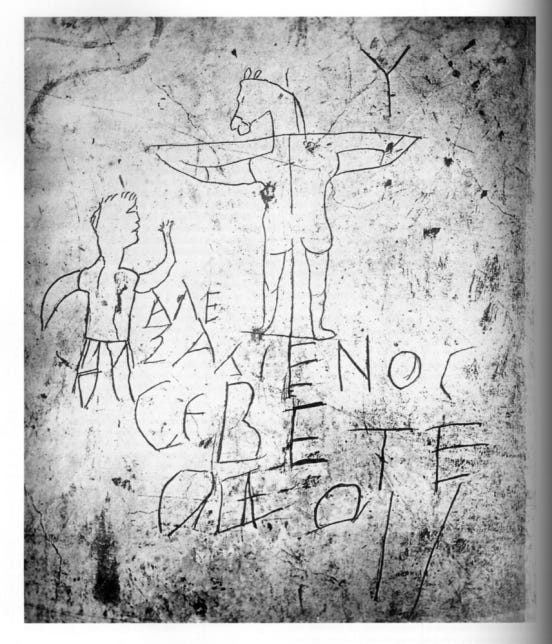
Derek Cooper writes somewhat humorously of the artistic merits of the Alexamenos graffiti:
It wasn’t the finest example of Italian art. Michelangelo, Raphael, Leonardo da Vinci—these artists would have surpassed this crude stage of drawing when they were mere bambinos….We don’t know the artist’s name, but we do know that he didn’t think highly of Christianity—and that he had never taken an art class.[1]
Admittedly, our graffiti does not take its place among the Italian greats. Even so, it depicts clearly enough what is happening. At the least, we can give the artist this: He managed to capture well the focus of Alexamenos’ gaze.
Alexamenos looks up at Jesus and gazes into his face. This is clear. His attention is captured and his gaze fixed.
Here is a seminal moment where the taunting artist did not realize that he was teaching good theology, for whatever else “worship” might mean, it certainly means seeing the object of our worship.
ALEXAMENOS
SEBETE
THEON
Alexamenos worships his God. And part of that depicted “worship,” was, tellingly, Alexamenos not merely seeing His God but looking at His God.
The focus of God’s people is addressed in more than a few ways in scripture. The language of “lifting up the eyes” permeates the text. Sometimes this “lifting” is merely functional. At other times, those in scripture “lift up their eyes” and discover the mighty works of God! Think of how Abraham lifted his eyes and saw the three visitors at the oaks of Mamre (Gen 18:2), how Abraham saw the ram in the thicket that took the place of Isaac on the altar (Gen 22:13), how David lifted his eyes and “saw the angel of the Lord standing between earth and heaven, and in his hand a drawn sword stretched out over Jerusalem,” leading to him and the elders repenting (1 Chron 21:16).
The phrase can also be a virtual synonym for worship. The psalmist, in Psalm 121, lifts up his eyes to the hills to discover “his help.” That help was found in the Lord alone.
In Psalm 123, there is a four-fold repetition of the image highlighting the importance of the people of God looking toward the Lord.
1 To you I lift up my eyes, O you who are enthroned in the heavens! 2 Behold, as the eyes of servants look to the hand of their master, as the eyes of a maidservant to the hand of her mistress, so our eyes look to the Lord our God, till he has mercy upon us. 3 Have mercy upon us, O Lord, have mercy upon us, for we have had more than enough of contempt. 4 Our soul has had more than enough of the scorn of those who are at ease, of the contempt of the proud.
The failure or inability to lift one’s eyes is also noted in scripture. In Luke 18, in the parable of the pharisee and the tax collector, the repentant tax collector’s is unable to lift his eyes.
9 He also told this parable to some who trusted in themselves that they were righteous, and treated others with contempt: 10 “Two men went up into the temple to pray, one a Pharisee and the other a tax collector. 11 The Pharisee, standing by himself, prayed thus: ‘God, I thank you that I am not like other men, extortioners, unjust, adulterers, or even like this tax collector. 12 I fast twice a week; I give tithes of all that I get.’ 13 But the tax collector, standing far off, would not even lift up his eyes to heaven, but beat his breast, saying, ‘God, be merciful to me, a sinner!’ 14 I tell you, this man went down to his house justified, rather than the other. For everyone who exalts himself will be humbled, but the one who humbles himself will be exalted.”
The inability to “lift up his eyes to heaven” is evidence of his fractured relationship with the Lord and of his humility. Yet, it was this man, Jesus tells us, who is justified, who enters into relationship with God.
Looking up at Jesus is also seen to be a source of immeasurable comfort for God’s people, especially in difficult times. For instance, in Acts 7, Stephen, in the midst of his own martyrdom, draws strength and, amazingly, joy by lifting his eyes to the Lord.
54 When the members of the Sanhedrin heard this, they were furious and gnashed their teeth at him. 55 But Stephen, full of the Holy Spirit, looked up to heaven and saw the glory of God, and Jesus standing at the right hand of God. 56 “Look,” he said, “I see heaven open and the Son of Man standing at the right hand of God.” 57 At this they covered their ears and, yelling at the top of their voices, they all rushed at him, 58 dragged him out of the city and began to stone him. Meanwhile, the witnesses laid their coats at the feet of a young man named Saul. 59 While they were stoning him, Stephen prayed, “Lord Jesus, receive my spirit.” 60 Then he fell on his knees and cried out, “Lord, do not hold this sin against them.” When he had said this, he fell asleep.
The graffiti artist’s depiction of Alexamenos gazing upward to the face of Jesus as an act of “worship” is one of the most startling examples of his inadvertently depicting what true and healthy Christianity is. He meant it as a taunt: “What kind of fool would gaze adoringly at such a monstrous and absurd spectacle?! Look at Alexamenos looking at his god! What a joke!” Yet, in fact, Alexamenos’ gaze is a challenge and an inspiration and a beautiful picture of devotion.
We are indeed to lift our eyes to the crucified Lord. Doing so is at the very heart of worship.
The Prioritizing Look
As a pastor, I have seen instances in which the averted gaze of believers leads them to distraction and to disgruntlement. I do not even need to approach this “as a pastor,” for I have seen the same in me.
The reality is, we are going to look at something, and the something at which we are looking is going to shape our trajectory and our constitution. The church is so constituted and commissioned that Christ and Christ alone is a worthy object for our gaze. Turning our eyes from Jesus is doubly tragic, as it turns out. It is tragic, first, because we take our eyes off our Savior. It is tragic, second, because we inevitably move our eyes to something inferior to our Savior and so sidetrack our own attention while distorting the lesser objection.
When churches split over the proverbial color of carpet, it is not really that they are thinking too much of the carpet, it is that they are thinking too little of Jesus. It is not a carpet problem. It is a Jesus problem. Turn your eyes from Jesus and focus on the carpet, in other words, and the carpet will be caricatured into something absurd and monstrous while the only object that can keep carpet carpet is neglected!
The small things look bigger than they are when the one big and true object of our faith, Jesus, no longer dominates the horizon of our sight.
“Where your treasure is, there your heart will be also” (Matthew 6:21).
Helen Lemmel put her finger on this truth beautifully in the refrain of her beloved hymn:
Turn your eyes upon Jesus,
Look full in His wonderful face,
And the things of earth will grow strangely dim,
In the light of His glory and grace.
It is only in looking “full” in the face of Jesus that “the things of earth…grow strangely dim.” If we do not, like Alexamenos, look upward into the face of Jesus, “the things of earth” will grow bigger and bigger!
Spurgeon
On January 6, 1856, a young man in Colchester, England, named Charles Haddon Spurgeon wondered into a Primitive Methodist chapel. There, he heard a curious sermon delivered in an uncouth manner that forever changed his life. Here is how Spurgeon remembers the episode:
I sometimes think I might have been in darkness and despair until now had it not been for the goodness of God in sending a snowstorm, one Sunday morning, while I was going to a certain place of worship. When I could go no further, I turned down a side street, and came to a little Primitive Methodist Chapel. In that chapel there may have been a dozen or fifteen people. I had heard of the Primitive Methodists, how they sang so loudly that they made people’s heads ache; but that did not matter to me. I wanted to know how I might be saved, and if they could tell me that, I did not care how much they made my head ache. The minister did not come that morning; he was snowed up, I suppose. At last, a very thin-looking man, a shoemaker, or tailor, or something of that sort, went up into the pulpit to preach. Now, it is well that preachers should be instructed; but this man was really stupid. He was obliged to stick to his text, for the simple reason that he had little else to say. The text was, “Look unto Me, and be ye saved, all the ends of the earth” [Isaiah 45:22].
He did not even pronounce the words rightly, but that did not matter. There was, I thought, a glimpse of hope for me in that text. The preacher began thus—"My dear friends, this is a very simple text indeed. It says, ‘Look.’ Now lookin’ don’t take a deal of pains. It ain’t liftin’ your foot or your finger; it is just, ‘Look.’ Well, a man needn’t go to College to learn to look. You may be the biggest fool, and yet you can look. A man needn’t be worth a thousand a year to be able to look. Anyone can look; even a child can look. But then the text says, ‘Look unto Me.’ Ay!” said he, in broad Essex, “many on ye are lookin’ to yourselves, but it’s no use lookin’ there. You’ll never find any comfort in yourselves. Some look to God the Father. No, look to Him by-and-by. Jesus Christ says, ‘Look unto Me.’ Some say, ‘We must wait for the Spirit’s workin.’ You have no business with that just now. Look to Christ. The text says, ‘Look unto Me.'”
Then the good man followed up his text in this way:—"Look unto Me; I am sweatin’ great drops of blood. Look unto Me; I am hangin’ on the cross. Look unto Me; I am dead and buried. Look unto Me; I rise again. Look unto Me; I ascend to Heaven. Look unto Me; I am sittin’ at the Father’s right hand. O poor sinner, look unto Me! Look unto Me!”
When he had gone to about that length, and managed to spin out ten minutes or so, he was at the end of his tether. Then he looked at me under the gallery, and I daresay, with so few present, he knew me to be a stranger. Just fixing his eyes on me, as if he knew all my heart, he said, “Young man, you look very miserable.” Well, I did; but I had not been accustomed to have remarks made from the pulpit on my personal appearance before. However, it was a good blow, struck right home. He continued, “and you always will be miserable—miserable in life, and miserable in death,—if you don’t obey my text; but if you obey now, this moment, you will be saved.” Then, lifting up his hands, he shouted, as only a Primitive Methodist could do, “Young man, look to Jesus Christ. Look! Look! Look! You have nothin’ to do but to look and live.” I saw at once the way of salvation. I know not what else he said,—I did not take much notice of it,—I was so possessed with that one thought. Like as when the brazen serpent was lifted up, the people only looked and were healed, so it was with me. I had been waiting to do fifty things, but when I heard that word, “Look!” what a charming word it seemed to me! Oh! I looked until I could almost have looked my eyes away. There and then the cloud was gone, the darkness had rolled away, and that moment I saw the sun; and I could have risen that instant, and sung with the most enthusiastic of them, of the precious blood of Christ, and the simple faith which looks alone to Him. Oh, that somebody had told me this before, “Trust Christ, and you shall be saved.”
Spurgeon would go on to be one of the greatest preachers of his or any other day. When he died, years later, thousands of people would parade past his casket in London. His Bible was opened on his casket to Isaiah 45:22: “Look unto me…”
It all started with a look—a look at the crucified Christ.
Alexamenos. Spurgeon. You. Me. We are to look and fix our gaze on Jesus.
This is what worships looks like.
This is who worships looks at.
[1] Cooper, Derek. Sinners and Saints. (Grand Rapids, MI: Kregel Publications, 2018) 75.
Hard to watch the Zeffirelli sequence after Pope Innocent III kisses his dirty feet and St. Francis keeps looking back & reaching out towards him as the distance between them grows and his little flowers pull him away & out of the building; how could anyone who watch that and not "tear up". Even after watching it many, many times down thru the years since my first viewing, the effect on me 'tis the same, a kind of joyous & also sad mysterious wonderment as their worlds part; pretty effective graphic bit of celluloid-acetate "majic". The Spurgeon testimony should remind us all, God uses what he chooses be it an uncuth commoner or 4 lepers @ the gate or a talking donkey as Balaam found out. His Word prevails throughout all the created order. Thank You Wym for a Gaze upward tied to the ancient past record. :-)
"My eyes are ever toward the Lord,
for he will pluck my feet out of the net." Psalm 25:15