
Che Observations
Some reactions to Jon Lee Anderson's Biography

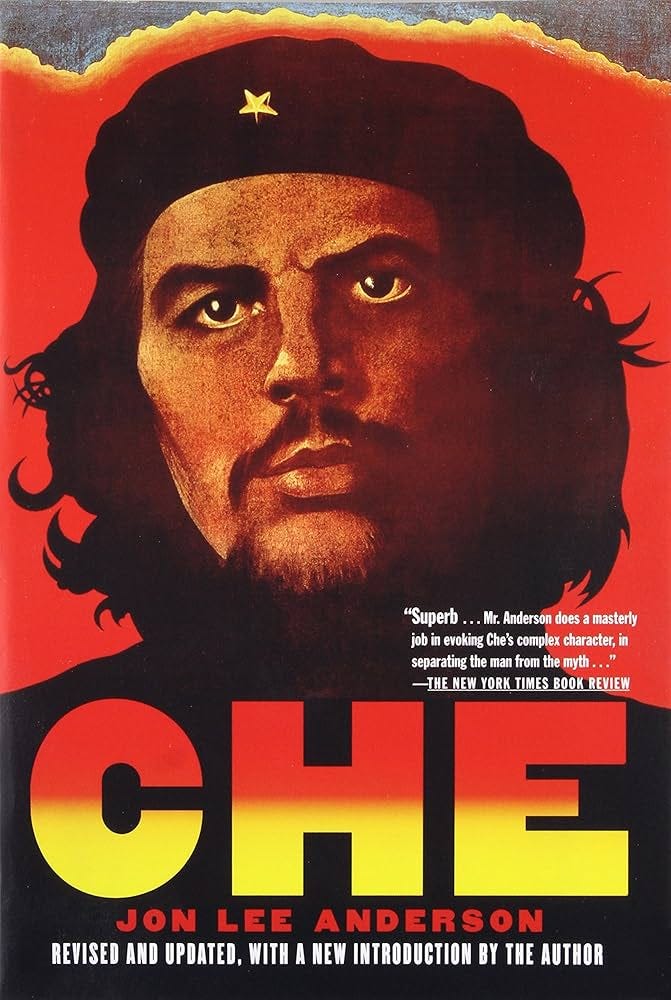
A couple of years ago, I went to Cuba on a mission trip. We were based in Santiago but traveled out from there into the countryside as well. While there, the images of Fidel Castro and Che Guevara were, of course, easy to find, especially in the countryside. When I returned, I purchased Jon Lee Anderson’s biography, Che, on Kindle. This is what I call a drive-time book, by which I mean I let Kindle read it to me via text-to-speech. Having just finished this, I wanted to offer some initial thoughts and reactions in no particular order.
The biography itself is fantastic: well-written, well-paced, informative, interesting, and thorough.
I am convinced that if Che Guevara had given his life to Jesus Christ and devoted himself to the expansion of the gospel and the Kingdom of God, he would have been the most effective missionary Latin America and possibly the world has ever seen.
But Che’s rejection of Jesus Christ was complete throughout his life.
Ernesto’s emerging worldview began to reveal itself in personal encounters. At the funeral of an uncle in 1951, he argued with his cousin Juan Martín Moore de la Serna, pitting his interpretations of Marx and Engels against Moore’s defense of French Catholic philosophers. On a visit to Córdoba, he mortified Dolores Moyano with a Nietzschean put-down of Jesus Christ.
[Anderson, Jon Lee. Che Guevara: A Revolutionary Life (Revised Edition) (pp. 89-90). (Function). Kindle Edition.]
and again:
On the day of Fidel’s second public statement, July 15, Ernesto responded defiantly to a remonstrative letter from Celia. Judging from his tone, she had questioned his motives for being involved with Fidel Castro in the first place, and wondered pointedly why he hadn’t been freed along with the others after their hunger strike…
“I am not Christ or a philanthropist, old lady. I am all the contrary of a Christ,” he wrote to his mother. “I fight for the things I believe in, with all the weapons at my disposal and try to leave the other man dead so that I don’t get nailed to a cross or any other place….What really terrifies me is your lack of comprehension of all this and your advice about moderation, egoism, etc…
[Anderson, Jon Lee. Che Guevara: A Revolutionary Life (Revised Edition) (pp. 293-294). (Function). Kindle Edition.]
Che was a pure ideologue with a ferociously evangelistic zeal for the spread of Communism around the entire world.
I was stunned to learn that Fidel was only 32 and Che was 30 when they began the Cuban revolution.
Che rejected the realpolitik that Fidel and others held to, when they felt they needed to. He was unbending in his belief that armed struggle was the only way for the ideals of Communism to take over the world. He was also unbending in his belief that Cuba need not cooperate with the United States at all and seethed at Castro’s occasional (and always thwarted) efforts to make overtures of peace and cooperation to the U.S.
Fidel seemed to love and appreciate Che but also seemed to not know what to do with him at times.
Che was fearless in articulating his ideals even if (as in the case of Cuba’s relationship with Russia) the expression of those ideals created very real problems for his friends.
Che’s preference for Chinese Communism over Russian Communism was fascinating.
Che had a nearly monastic and possibly maddening devotion to his cause including the asceticism often required by it. He was not averse to suffering for his ideals…or to killing for them. More than once while listening to this book, Nietzsche’s famous line came to my mind: “All truths are bloody truths to me.” In a chilling paragraph, Anderson writes:
Indeed, Che’s “Message to the Tricontinental” had caused a sensation. He had appealed to revolutionaries everywhere to create “two, three, many Vietnams.” Opening with a quote from José Martí, “Now is the time of the furnaces, and only light should be seen,” Che questioned the validity of the so-called peace of the postwar world and demanded a “long and cruel” global confrontation to bring about the destruction of imperialism and a new socialist world order. In a litany of the qualities that would be required for this battle, he cited hatred as a prime element: “a relentless hatred of the enemy, impelling us above and beyond the natural limitations that man is heir to, and transforming him into an effective, violent, seductive, and cold killing machine. Our soldiers must be thus; a people without hatred cannot vanquish a brutal enemy.”
[Anderson, Jon Lee. Che Guevara: A Revolutionary Life (Revised Edition) (p. 1003). (Function). Kindle Edition.]
Che hated what he saw as the imperialism of North America.
Che could be bitingly cruel to people, even to his friends, and his tongue was his most deadly weapon.
There was also an attractive appeal to Che that those around him often found overwhelming.
Che did seem indeed to have a genuine desire for the betterment of the poor.
Che’s atheism was entrenched and, at least insofar as Anderson tells the story, he never wrestled with any doubt on the issue.
Che’s efforts in the Congo as well as in Bolivia show how really amazing it is that the revolution succeeded in Cuba. So many things have to line up just so for such a daring attempt to actually work. Both the Congo and Bolivia were absolute disasters.
There are aspects of Che’s character that are admirable: his devotion to his ideals, his hatred of the hypocrisy he saw in some who claimed to be part of the socialist movement, his fearlessness, his desire to see his ideals spread all over the world. I am speaking here of the ideals themselves, not that to which he attached them: Communism. In a day of constant vacillation and equivocation, this much should be said: People who actually believe what they profess to believe with very little disjunction between their creed and their character is rare indeed. I do very much respect, on principle, dogged conviction. At the very least one can speak to such a person knowing who they actually are. That was certainly the case with Che. He very much was who he was and did not wear a mask.
There are aspects of Che’s character that are not admirable. As Anderson puts it:
Che’s unshakable faith in his beliefs was made even more powerful by his unusual combination of romantic passion and coldly analytical thought. This paradoxical blend was probably the secret of the near-mystical stature he acquired, but it seems also to have been the source of his inherent weaknesses—hubris and naïveté. Gifted at perceiving and calculating strategy on a grand scale, yet at a remove, he seemed incapable of seeing the small, human elements that made up the larger picture, as evidenced by his disastrous choice of Masetti to lead the Argentine foco. There, and in Cuba, the Congo, and Bolivia, the men he believed in consistently failed him, and he consistently failed to understand how to alter the fundamental nature of others and get them to become “selfless Communists.”
[Anderson, Jon Lee. Che Guevara: A Revolutionary Life. (Revised Edition) (p. 1054). (Function). Kindle Edition.]
Che’s rejection of the Christian gospel was a tragedy. Che proved G.K. Chesterton’s observation in Christendom in Dublin, “Once abolish God and the state becomes God.” Or, if not the state, then one’s political ideals.
A provocative proposal with no intended hyperbole: Had Che followed Christ instead of communism, he would have been very much like Francis of Assisi. I really mean that. There are a number of fascinating parallels, not the least of which is radical identification with the poor and a ruthless push toward the logical outworking of one’s ideals no matter how overwhelming others who are sympathetic to the vision might find that push. But one’s starting point inevitably shapes one’s means and, ultimately, one’s end.
I highly recommend this biography.