
Chapter 18, "Stumphouse" / Alexamenos
How an 1800-year-old Anti-Christian Graffiti in Rome Can Teach us about Jesus and What it Means to Follow Him

Foreword by John Michael Talbot
Circa 200 AD
Paedagogium, Palatine Hill
Rome
“Hold the light steady right there.”
The young man whispered to his compatriot quietly in the shadow of the small room. This young man—training in this place to serve as a page in the palace but holding higher aspirations for service in the army or even, were the gods so inclined, for the Praetorian Guard—very much wanted his creation to be a surprise.
He snickered as he worked. So did his friend who held the flickering candle near the section of plastered wall. It was not hard to find a flat surface in the paedagogium. It could, however, be hard to find a blank place large enough for him to put his drawing amidst the other graffiti that crowded the wall.
He leaned in, stylus in hand, scraping carefully but quickly at the wall. He was not afraid of being caught. Most of his friends were going to find this creation hilarious. He just wanted his buddies to see it in the morning in all of its glory for full dramatic effect.
More than anything, he wanted one particular young man to see it. A slave boy training, like himself, in the paedagogium, for service in the palace. A boy named Alexamenos.
The idea had first occurred to him when he learned that Alexamenos was a member of the strange Jewish sect, the Christians. Alexamenos was not the first Christian he had ever met, but he was the first Christian he had ever seen up close, practicing his religion.
He had been sitting behind Alexamenos once while their tutor instructed them on some forgotten matter of palace protocol. The ones among them who could write, many of whom were being trained to be scribes, were taking simple notes on the points of instruction. In a haze of boredom, his eyes had drifted to Alexamenos’ tablet. “Not bad handwriting,” he had thought. Then, “But, wait, what is that?” As Alexamenos had not detected the prying eyes yet, he leaned in closer and squinted, looking at the upper corner of the boy’s tablet. “No…you have got to be kidding…” But, sure enough, there it was. Drawn so small as to be almost unnoticeable, Alexamenos, perhaps in a moment of his own boredom, had drawn a crux.
“By the gods,” the boy thought! “Those people really do worship a crucified god. What absolute insanity! How grotesque!” And then, more: Alexamenos, still unaware that he was being watched, briefly and gently placed a finger on the cross while his lips moved silently, as if in prayer.
Stunned, the watching boy leaned back on the bench.
There had been rumors, sure, but now it was confirmed: Alexamenos was a Christian and he prayed to a crucified god.
The boy thought about it the rest of the day. He came close to telling some of his friends, but thought better of it. No, this required more than just schoolyard gossip. This required something…special.
So late that night, he grabbed one of his friends and said, “Get a candle and come with me.” And he began his great work.
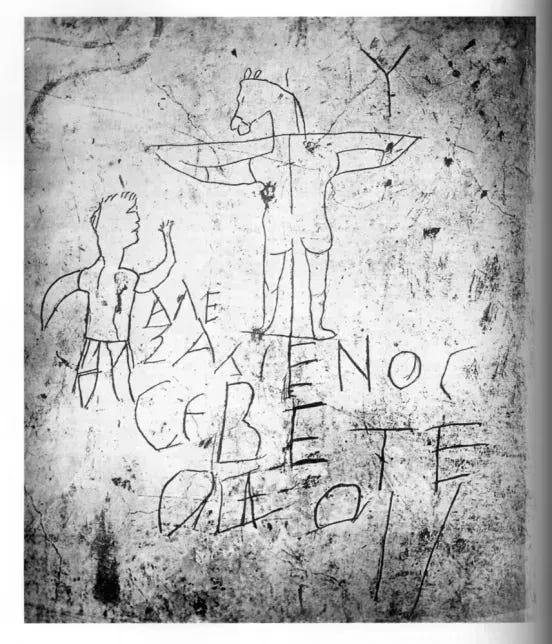
First a cross. Then, on the cross, Christus, the god of the Christians. He drew him wearing a colobium, but one that did not quite cover his buttocks. At this, he paused and the two boys burst into laughter that they quickly tried to stifle. But there was more. This god also needed something special. A favorite insult that was popular at the time gave him an idea. He had heard his tutor use the insult more than once. It always made him laugh. He returned to his work. A large head, elongated, the unmistakable ears, the leftward gaze.
Then, to the left of the cross, Alexamenos himself, similarly wearing a slave tunic. Then, the thrown hand of prayer, the way some of the Romans occasionally threw kisses to the statues of the gods. And the upward look: Alexamenos looking stupidly at his monstrous god.
Lastly, a final touch: an inscription. “Alexamenos sebete theon.” “Alexamenos worships his god.”
“I must say, you have outdone yourself,” his friend said! “Tomorrow is going to be a riot!”
The next morning, Alexamenos heard the laughter before he entered the room, but this was not an unusual sound for the paedagogium. But when he entered, the room full of boys positively erupted into guffaws. “There he is! He has stopped his worshiping to join us!”
Alexamenos stood in a state of confusion. Finally, “What?”
At this, one of the boys came forward, threw an arm around him, and led him to the wall as the crowd of boys parted ways.
And, then, he saw it.
He saw himself.
He saw Jesus.
The look. The cross. The slave tunic. The exposed posterior. The donkey head. And the words.
“Alexamenos worships his god.”
He stared at it. He felt the blood drain from his face. At first, shock. Then, the tears started coming. “No, no. Not that. Please, Jesus, not that.”
He felt embarrassment.
He felt anger.
But there was something else. Something very deep inside that was slowly making its way forward. A voice other than the cackling voices of his peers. And this voice was not laughing. This voice was strong, but tender. It was a voice of understanding. And it spoke to him.
“Courage, Alexamenos. Courage. I see you. I am here.”
Circa 1990 AD
Stumphouse Tunnel
Wallhalla, South Carolina
“Hold the light steady right there.”
My father’s voice was soft and the words were offered almost as an aside as he studied the blue granite wall of the tunnel. There was no reason to be loud. Every sound echoed and seemed magnified in the still air.
It can be hard to find a dry stretch of granite inside Stumphouse Tunnel. The condensation keeps the entire atmosphere in a state of perpetual damp. The tunnel was one of the recurring haunts of my youth. My father, Wade Richardson, would take my brothers, David and Condy, and me to the upstate of South Carolina where we would camp in Oconee State Park and explore the Blue Ridge foothills and all that they had to offer. Going into Stumphouse Tunnel was always a highlight.
Stumphouse makes an impression. Originally proposed by citizens of Charleston, SC, in 1835, the plan was to cut through the Blue Ridge with a series of tunnels that would, when finished, make it possible for a train to run from Anderson, SC, to Knoxville, TN. Progress apparently went according to plan until the state decided it had spent enough on the tunnel, and this, even though only 1,617 of the proposed 5,863 feet had been blasted clear. But with one million 1856 dollars spent, the plan was abandoned.
All the better for the brothers Richardson, of course, as well as for the countless others who thrilled to go deep into Stumphouse, observing its massive air shaft, little bats, and bore and blast marks along the way to its dark, damp, eery terminus. Would I have allowed my mind to go there, I suppose I could have convinced myself that I could hear the whispers of the fifteen hundred Irishmen who labored to blast that tunnel into that mountain over one hundred and thirty years before.
When I think of Stumphouse now, however, my mind goes less to the vague but soothingly euphoric nostalgia of the place than it does to a very specific memory. I was in tenth grade. My father had taken me and a friend of mine, Justin Snell, on a camping trip. We had traveled to the back of Stumphouse Tunnel and were coming out when my father stopped, studied a section of the cool blue granite wall, then said, “Hold the light steady right there.”
I did so. He pulled from his coat pocket a small hammer and a one-inch coal chisel. He had come prepared for this. He put the chisel to the granite, and then struck it. The ping of the hammer hitting the little chisel would have sounded diminutive and weak compared to the heavy blows that the original excavators would have inflicted on the walls, but my father, partially of Irish descent himself, stood in unironic solidarity with these long-deceased men when his little chisel cut into the flat stone section of wall.
But what was he doing?
Ping. Ping. Ping.
First a vertical line, just a few inches high. Then he measured down from the top a bit and—ping, ping, ping—added a horizontal line.
He finished and stepped back.
We looked.
A cross.
It glinted faintly in reflection of the flashlight as a distinct silvery intrusion into the rock.
It was quiet there in Stumphouse. Then my father spoke. “That’ll be there long after we’re gone. One of these days somebody will see that cross and say, ‘I wonder who put that there?’”
My dad. My friend. Myself. The cross.
We were believers, we three. We knew what that cross chiseled in that wall meant. We knew, and it did not need to be said. But we knew and now we remember.
And that cross is still there, on that wall.
And years from now somebody will see it.
They will see it and they will wonder who chiseled it and why.
They will see it and they will wonder what story lay behind it.
But it will be there: The cross, the gospel, and the crucified and risen King.
And people will still be calling Him Lord.
OK then. A flickering moment of High Strangeness with 3 wisemen offering a gift to the ancient mountain's scarred inward parts as a gesture of Peace inviting a wee bit more acceptance that the best laid plans of mice & men often go awry and that one day soon a New World will come forth. :-)